|
|
 |
 |
 |
 |
|
Weekly Torah Reading
|
|
|
|
Parashat Chayei Sarah ("the life of Sarah")
|
|
|
Click on the links to display the Scriptures:
|
|
|
|
 |
 |
 |
|
Torah Reading Snapshot:
|
|
|
|
Last week's parashah (Vayera) recounted how the LORD was faithful to Abraham and Sarah by miraculously giving them a son (Yitzchak) in their old age. However, after repeated testing, Abraham faced his greatest test of all by offering up his child of promise as a sacrifice on Mt. Moriah, the place of the future Temple. On account of Abraham's willingness to obey, the LORD promised that He would multiply his offspring as the stars of heaven and that in his Seed (singular) all the nations of the earth would be blessed.
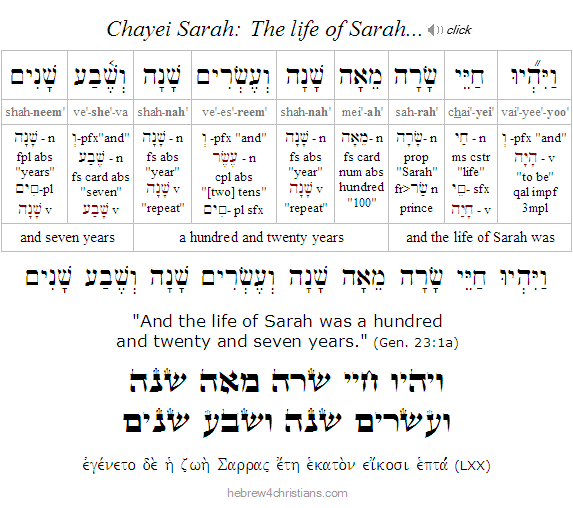
This week's parashah, Chayei Sarah - the "life of Sarah"- begins (paradoxically) with the account of Sarah's death:
|
|
|
 |
 |
|
And Sarah was a hundred and seven and twenty years old: these were the years of the life of Sarah. (Gen. 23:1)
|
 |
 |
|
Abraham had encamped at various times at the trees of Mamre, just east of Hebron, and this is the place where Sarah, the mother of the Jewish people, died at the age of 127 (some of the Jewish sages have said that the shock of the Akedah - the near sacrifice of Isaac - is what killed her). After mourning for Sarah, Abraham spoke to the sons of Heth (bnei Chet) saying that he was ger v'toshav (a stranger and a sojourner) among them, and asked to bury his wife in the nearby Cave of Machpelah (thought by the sages to be the resting place of Adam and Eve). Abraham inquired about the price for the cave and field, and without any negotiation, paid Ephron the Hittite's asking price of 400 shekels of silver - an exorbitant price - in the full presence the leaders of the Hittites. He then buried Sarah in the cave among the people of the Hittites. (Abraham's insistence upon separate Jewish burial site is part of Jewish law to this day; reflecting the Jew's role in life and society- "a stranger and a sojourner"- here, yet not here.)
After this, Abraham's servant, Eliezer of Damascus (the one Abraham had originally thought would be his heir), made a covenant with Abraham to find his son Isaac a wife from among his relatives living in Mesopotamia - and not from among the Canaanites. Eliezer took the oath and set out on the 500 mile journey to Haran (also called the city of Nahor and the place where his father Terah died), taking ten camels laden with gifts in search of Isaac's bride.
At a city well near Nahor, Eliezer made the camels kneel down and asked the LORD for a sign: when the maidens would come to the well, he would ask some for water to drink, but the woman who offered to also draw water for his camels as well (roughly 140 gallons!) would be the one chosen by the LORD for Abraham's son.
As if scripted by hashgachah (divine providence), before he had finished praying, Rivkah (Rebecca), Abraham's nephew's daughter, came out with her water jar on her shoulder. Eliezer ran to her and asked her for a drink, and after giving him some water, generously offered to draw water for all ten of his camels. After she "passed the test," Eliezer gave her expensive rings and bracelets and inquired of her family status. When he learned that the LORD had led him directly to Abraham's direct kinsmen (Rebecca was the granddaughter of Abraham's brother Nachor), he was overjoyed and thanked the LORD for guidance and success.
Meanwhile Rebecca ran home to tell her family what happened and her brother Lavan (Laban) went out to invite Eliezer to come under their hospitality. Eliezer agreed but refused to eat with them until he had clearly communicated the purpose of his mission and fulfilled his promise to his master Abraham.
Eliezer told Abraham's nephew Bethuel and his family the entire story of his journey from Abraham in Canaan, including his prayer to the LORD for the sign of a wife for Abraham's son, and how Rebecca had passed the divine test. He then asked them whether they would show kindness to Abraham and agree to give Rebecca as Issac's wife -- or not, in order that Eliezer would know whether to "turn to the right hand or to the left."
Both Bethuel and Laban agreed that the LORD had indeed chosen Rebecca to be Abraham's son's wife and did not object to the match. Upon hearing this, Eliezer gave Rebecca more gifts and also gave gifts to the rest of the family. They then ate a meal together and spent the night.
The following morning, Eliezer wanted to leave for Canaan with Rebecca, but her parents wanted her to stay another ten days. When they finally asked her if she was willing to depart immediately, she said she was, and left for Canaan without further delay with her maidservants. Eliezer then led Rebecca back to the land of Canaan, where she met and married Isaac. Isaac loved her and was comforted over the loss of his mother Sarah.
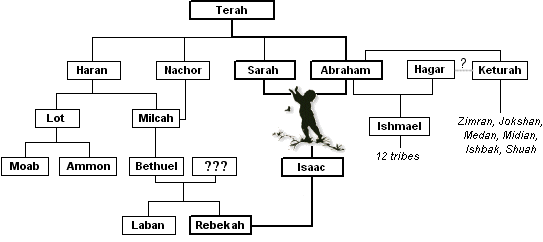
We are then told that, in his old age, Abraham was married again to Keturah (some claim that she was actually Hagar) and had 6 more sons. Abraham gave gifts to these children as a legacy, but left everything else he owned to Isaac, the appointed heir.
The parashah ends with Abraham's death (at age 175), and how his two sons (Isaac and Ishmael) buried him in the Cave of Machpelah next to his wife Sarah. As a postscript, we are also told of the descendants of Ishmael and of his death (at age 137):
|
 |
 |
 |
 |
 |
 |
 |
 |
 |
|
Haftarah Reading Snapshot:
|
|
|
|
The Haftarah for Parashat Chayei Sarah contrasts the aging and death of King David with that of Abraham. Both were old men; both had appointed successors; but Abraham's house was full of shalom and grace, whereas David's house was full of strife and intrigues.
As King David grew old and was ready to die, his spoiled son Adoniyahu (Adonijah) attempted to usurp the throne for himself (the Tanakh explains the source of this rebellion as a lack of fatherly discipline, see 1 Kings 1:6). Like Sarah's intervention to remove Ishmael from the chosen line, David's wife Bat Sheva (Bathsheba), the mother of Solomon (along with Nathan the prophet) aroused him to quell the rebellion and to name Solomon as the rightful successor to the throne.
Since King David represented the beginning of the Dynasty of Jewish Kings which would ultimately appear in the person of the Mashiach, it was crucial that the divine election of Solomon would take place, according to prophecy. This would ensure that the Temple would be built and that the Mashiach would eventually come to redeem Israel. Yeshua the Mashiach is a direct descendant of King Solomon (Matt. 1:7; Luke 3:20-31).
|
|
|
Brit Chadashah Snapshot:
|
|
|
|
The readings from the Brit Chadashah concern the Greater Seed of Abraham and the Son of David, Yeshua the Mashiach of Israel.
In the reading from Matthew, the genealogy of Jesus is given through the lineage of Joseph (Luke gives another genealogy tracing descent backwards from Mary). Matthew follows the line of Joseph (Jesus' legal father), through David's son Solomon, while Luke follows the line of Mary (Jesus' blood relative), though David's son Nathan. Through either line, then, Jesus is a descendant of King David and therefore eligible to be the Mashiach of Israel.
The passage from 1 Corinthians 15 tells us that flesh and blood cannot inherit the kingdom of God, nor can the "perishable inherit the imperishable." Sarah died. Abraham died. King David died. But there is a mystery awaiting us all, since at the sound of the "last shofar," in the twinkling of an eye, the dead will be raised and transformed into immortal bodies (techiyat hametim). When this occurs, death itself will be "swallowed up in victory" since Yeshua our LORD delivered us from the kelalah (curse) of the law's verdict against us. On account of God's love and grace, then, we can rejoice that "love is stronger than death," and the ultimate victory over the ravages of sin will forever be reversed on behalf of Jesus our LORD and Redeemer.
|
|
|
 |
|
|
|
Addendum:
|
|
|
|
The Greatness of Sarah
|
|
|
|
Despite the custom of greeting an elderly man or woman on their birthday with the wish: "May you live to be 120" (the age at which Moses died), in Jewish thinking birthdays are not regarded as important as the day of one's death. And since this week's Torah portion concerns the death of the first great matriarch of the Jewish people, I thought it would be worthwhile to discuss some of the wonderful things about this amazing woman of valor....
First of all, in Jewish tradition Sarah Imenu ("Our mother Sarah") is considered one of the four most beautiful women who ever lived (the other three include Abigail, Rahab, and Esther). The Bava Basra says that compared to Sarah, other women looked like "monkeys" (58a). According to Rashi (and others), Sarah was not only beautiful, but entirely modest and innocent. Indeed, by the time she gave birth to Isaac, she was regarded as virtually sinless (Bereshit Rabbah 58:1). The Talmud (Megillah 14a) explains that Iscah was another name for Sarah (Gen. 11:29), meaning "to gaze." This name described both Sarah's ability to gaze into the future by Divine inspiration (Sarah was a great prophetess) and because everyone gazed at her beauty. It is noteworthy that the Hebrew word for face, "panim," is written exactly the same way as the Hebrew word for inside, "penim," suggesting that Sarah's beauty was both external and internal.
Sarah's modesty and high calling, however, prevented her from viewing herself as the world did. At first she was named Sarai (שָׂרַי, "my princess"), a name apparently given to her from birth. With her great beauty, she surely could have had become a princess of Egypt, even a wife of Pharaoh (Gen. 12:11-20), but she instead chose to suffer as a "stranger and a pilgrim" in this world with her husband. Because of her faith in the promise of the LORD, she was renamed Sarah (שָׂרָה, "princess"), that is, princess of the whole world. As such, Sarah is considered a true heroine of the faith (Heb. 11:11). Regarding Sarah's name change, the Yod (whose numerical value is 10) was "taken" from Sarai and divided into two Heys (whose numerical value is 5). Half was given to form the name Sarah and the other half was given to form the name Abraham (from Abram).
Though Sarah did not hear the Divine Voice that commanded Abraham to leave for an unknown land, she willingly joined her husband and ventured in faith. Along the way, she underwent the same trials that Abraham faced (see below on the "Ten Trials of Abraham") but she never turned back to the world she left behind.

Indeed, from the time she arrived in Canaan, Sarah was tested and refined by the LORD. For 25 years she waited to become a mother -- despite God's promise to her. She later got entangled with the intrigue and heartache over Hagar, her handmaiden turned rival... But though she was well past the age of bearing children, she never lost hope... According to midrash, at age 90 Sarah did not have a womb but God supernaturally created one for her. Isaac was conceived in a manner similar to Mary, the mother of Yeshua, and the angel of the LORD was likewise dispatched to personally give her the tidings of her pregnancy (Bava Metzia 86b).

The Midrash states that throughout the years that Sarah was alive, the Divine Presence hovered as a cloud over her tent, the doors of the house were open wide, her dough was blessed (i.e., more than enough to give to all), and a lamp burned in her tent from one Sabbath eve to the next. Sarah undoubtedly had a great sense of humor, as well, and the LORD used her laughter as the basis for her promised son's name (Yitzchak comes from the root צָחַק meaning "to laugh"). When she died, all of these things ceased, but when Rebecca came, they all returned (Bereshit Rabbah 60:16).
Sarah was without a doubt an equal to Abraham, and perhaps even his superior in matters of the heart and spirit. After all, when Sarah wanted Ishmael sent away because of his evil influence on Isaac, Abraham was uncertain until God Himself validated Sarah's decision: "All that Sarah tells you, listen to her voice" (Gen. 21:12). Rashi notes that this indicates that Sarah was on a higher prophetic level than her husband Abraham. "Who are the seven prophetesses? Sarah, Miriam, Deborah, Hannah, Abigail, Hildah, and Esther" (Megillah 14a). When she was abducted in Pharaoh's harem, for example, Abraham was told by an angel not to fear for her safety, since the Divine Presence surrounded her. The plagues sent on Pharaoh's Egypt prefigured the greater deliverance to come for her children.
Moreover, Abraham's spiritual journey effectively came to an end with the death of Sarah, even though he outlived her by some 38 years. There is no further dialog recorded between God and Abraham after Sarah's death, and even the last recorded act of Abraham -- i.e., seeking a wife for Isaac -- is the result of Sarah's will for her son. According to various sages, Sarah's 127 years amounted to exactly the same number of years as Abraham "Ha-ivri" ("the one who crosses over"). Since Abraham was 48 years old when he first recognized the One True God, and a convert is considered as a newborn, then Abraham, who died at 175, lived exactly as long as did his wife Sarah. Rashi says that Sarah's 127 years were composed of three overlapping qualities: she was as innocent as a 7-year-old, with the strength and idealism of a 20-year-old, and yet she always possessed the wisdom of a 100-year-old.
Lastly, when Sarah died, she was the very first Jew to be buried in the Promised Land. According to tradition, she (not Abraham) was the one who planned to purchase the Cave of Machpelah ("the Cave of Pairs") at Kiriat Arba ("City of Four," so named because four couples are said to be buried there: Adam and Eve, Abraham and Sarah, Isaac and Rebecca, and Jacob and Leah).
|
|
|
|
Blessing:
|
|
 |
|
|
 |
|