|
|
 |
|
|
The Jewish Holidays
|
|
|
|
|
|
The Appointed Times of the LORD...
|
|
|
|
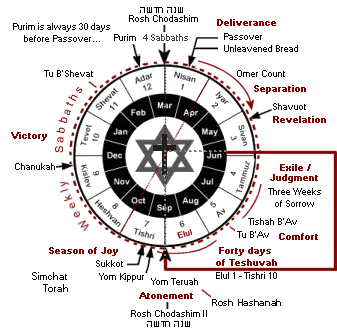
This section of the site provides information about the most significant mo'edim (or "appointed times") that are important to Jews all over the world. All of the Biblical mo'edim are prophetic and reveal great truth about the plans and counsel of the LORD God of Israel. Therefore they are also called "the feasts of the LORD" (מוֹעדי יהוה).
Note: For Jews living outside Israel, major Jewish holidays (except for Yom Kippur) are often observed for an additional day (called yom tov sheni). [more]
|
|
|
Introduction
|
|
|
|
|
|
|
The feasts and holidays of the LORD are part of the larger mosaic of Jewish time that expresses the corporate life cycle of Jews all over the world.
|
|
|
|
The Jewish Day
|
|
|
|
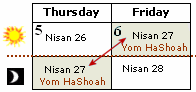
Since the Torah's day (יום התורה) begins at sundown, you must remember that a given holiday actually begins on the night before the day listed in a Jewish calendar. For example, Yom HaShoah (Holocaust Memorial Day) occurs on Nisan 27, which actually begins after sundown, Nisan 26:
|
|
|
|
|
|
Thus a given Jewish holiday spans two days on our Gregorian calendar. Most Jewish calendars do not indicate the previous night as part of the holiday. Observance of a holiday begins at sundown on the day before it is listed in the calendar!
|
|
|
|
|
In the example above, Yom HaShoah (ום השואה) is observed both on Thursday the 5th (after sundown) and Friday the 6th (during daylight hours).
Note that if a given holiday were to occur on a Sabbath, it would be moved to the previous Thursday on the calendar. For example, if Nisan 27 happened to begin on Friday at sundown, it would be moved to Nisan 26. Accessing a current Jewish calendar is essential to observing the mo'edim!
|
|
|
|
The Torah's week (שבוע התורה) begins on Sunday and ends on Saturday (Shabbat). The Jewish sages have argued that Shabbat is the most important of the mo'edim, since it is explicitly commanded to be observed in the Aseret HaDiberot (Ten Commandments).
|
|
|
|
|
|
- The Sabbath foreshadows the olam habah (world to come) and our restored dignity as children of the New Covenant.
- Weekly Torah Readings are considered appointments with the Bat Kol, the Voice of the LORD.
|
|
|
|
|
The Jewish Month
|
|
|
|
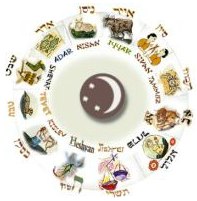
The Torah's month (חודש התורה) is based on the lunar cycle, and Rosh ha'Chodesh ("the Head of the Month") symbolizes the renewal of the new moon (month), when the moon appears as a sliver in the sky. Rosh Chodesh is marked by special liturgy.
|
|
|
|
|
|
|
|
- Rosh Chodesh (ראשׁ חדשׁ) symbolizes renewal and restoration. Just as the moon wanes and disappears at the end of each month, but returns and waxes again to fullness, so we suffer until the return of our beloved Mashiach Yeshua, who will restore the glory of God fully upon the earth.
|
|
|
 |
|
|
|
|
|
The Spring Holidays
|
|
|
|
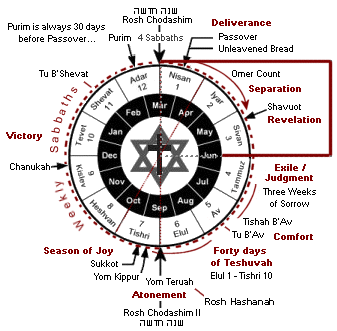
Spring is the start of the Biblical Year and is marked by two of the Shelosh Regalim (three annual pilgrimage festivals): Pesach (Passover) and Shavuot (Pentecost). Shavuot is held seven weeks (or fifty days) following the morning after Pesach.
|
|
|
|
|
|
 |
|
|
|
The spring holidays (חגי האביב) reveal the first coming of Yeshua (as Mashiach ben Yosef) and provide a portrait of the death, burial, and resurrection of the Messiah: Yeshua was crucified on erev Pesach (during the time of the sacrifice of the Passover lambs), buried during Chag Hamotzi (the festival of Unleavened Bread), and was resurrected from the dead on Yom Habikkurim (the Day of Firstfruits). Fifty days after Passover, on the climactic holiday of Shavuot (i.e., the feast of Pentecost), the Ruach HaKodesh (Holy Spirit) fell on the believers in fulfillment of the promise given by our Lord. Note both that the giving of the Holy Spirit occurred precisely according to the calendar countdown given in the Torah (Lev. 23:15-16) and that it occurred after the cross of Yeshua -- just as our Messiah foretold (Acts 1:6-8, Acts 2:1-4). This proves that the feasts of the LORD (מוֹעדי יהוה) were not abolished after the crucifixion of the Lord. The meaning of the gospel is prefigured and told in the holidays given in the Torah. See Luke 24:27, 24:44; John 5:46; Acts 26:22, etc.
The Spring Holidays:
- Passover (Pesach) - Celebration of freedom (Major Holiday)
- Pentecost (Shavuot; Chag HaBikkurim) - The giving of the Torah at Sinai and the Ruach HaKodesh (Holy Spirit) to the Church at Zion [Sivan 6-7] (Major Holiday)
|
|
|
|
|
|
|
|
The Summer Holidays
|
|
|
|
In the summer there occurs a three week period of mourning that begins with the Fast of Tammuz and ends with tragic holiday of Tishah B'Av. The last nine days of this three week period (i.e., from Av 1 until Av 9th) are days of increased mourning. After this somber time, however, the romantic holiday of Tu B'Av, the 15th of Av occurs. Originally a post-biblical day of joy, the 15th of Av served as a matchmaking day for unmarried women in the Second Temple period.
|
|
|
|
|
|
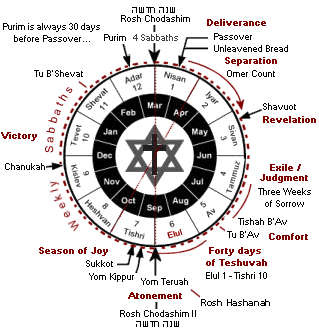
The summer holidays (חגי הקיץ) conclude with the 30 days of the month of Elul, a yearly season of teshuvah (repentance) that anticipates Rosh Hashanah and the fall holidays. The days of Elul are combined with the first ten days of the month of Tishri to create the Forty Days of Teshuvah (ארבעים יום תשובה) that culminate with the holy day of Yom Kippur.
|
|
|
|
The summer holidays help us prepare for the second coming of the Messiah:
The Summer Holidays:
|
|
|
|
The Fall Holidays
|
|
|
|
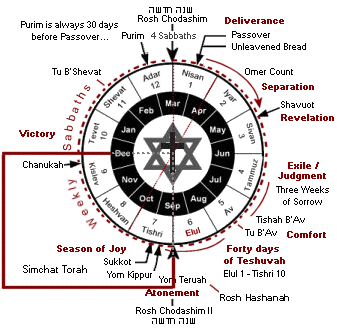
The fall holidays (חגי הסתיו) prophetically indicate the great Day of the LORD (יוֹם־יְהוָה), the second coming of Yeshua, the great national turning of the Jewish people, and the establishment of the reign of the Messiah over the earth during the Millennial Kingdom.
The Fall Holidays:
- Yamim Nora'im (Days of Awe):
- 3. Tabernacles (Sukkot) - The world to come (Major Holiday) [Tishri 15-21]
- Hoshana Rabba - The seventh day of Sukkot [Tishri 21]
- Shemini Atzeret - The 8th day of assembly following Sukkot [Tishri 22]
- Simchat Torah - Celebration of the giving of the Torah [Tishri 23]
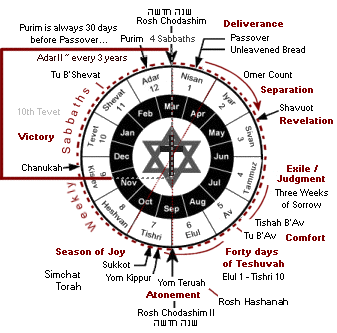
- Chanukah (Dedication) - late fall/early winter: Victory; [Kislev 25 - Tevet 3]
|
|
|
|
The Winter Holidays
|
|
|
|
Since the creation of the State of Israel in 1948, the Chief Rabbinate of Israel has established four new national holidays (חגי ישראל), three of which occur in the month of Iyyar (Apr/May):
- Yom HaShoah - Holocaust Memorial Day [Nisan 27]
- Yom Hazikaron - Israel Memorial Day [Iyyar 4th]
- Yom Ha'atzmaut - Israel Independence Day [Iyyar 5th]
- Herzl Day - Honoring the Zionist leader Theodor Herzl [Iyyar 10th]
- Yom Yerushalayim - Jerusalem Reunification Day [Iyyar 28th]
|
|
|
|
|
|
Fast Days of the Year
|
|
|
|
In addition to Yom Kippur, the Talmud (Tractate Rosh Hashana 18b) discusses four fast days (ימי צום) based on Zechariah 8:19 that commemorate the destruction of the First and Second Temples and the exile of the Jewish People from their homeland. In addition, two other fast days are mentioned in the Rabbinical literature, yielding a total of six prescribed fasts (seven if Yom Kippur is included).
|
|