|
|
 |
|
|
|
|
Weekly Torah Reading
|
|
|
|
Parashat Shelach Lekha ("Send for yourself!")
|
|
|
Click on the links to display the Scriptures:
|
|
|
|
|
|
|
|
Torah Reading Overview
|
|
|
|
The Israelites had been through a lot after their miraculous deliverance from Egypt by the Hand of the LORD. First they were led to Mount Sinai, where Moses was given the Torah and the people were ratified as God's covenant children. Next, the Levitical priesthood was established and the tribes of Israel were meticulously arranged into military camp formation around the Mishkan - the dwelling place of the LORD. After camping at Sinai for nearly a year, the Israelites were led by the Shekhinah cloud by day and the pillar of fire by night en route to the Promised Land - the land of Canaan - which the LORD swore to give to Abraham and his descendants forever. All these events happened during the first 13 months after leaving Egypt!
|
|
|
|
|
|
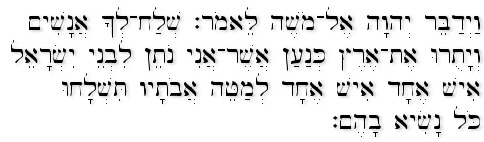
Our parashah opens with the Shekhinah leading the Israelites near the land of Canaan and the LORD instructing Moses to send twelve spies - one nassi, or prince from each of the twelve tribes - to go into the land of Canaan and to bring back a report:
|
|
|
|
Jewish tradition suggests that b'nei Yisrael (the children of Israel) suddenly became fearful at the prospect of leaving Sinai to conquer the Promised Land. After all, the seven Canaanite nations living there had a reputation of being fierce and depraved, and the people were unsure how they would be able to defeat them in battle. Therefore they asked Moses to send meraglim (spies) ahead, in order to assess the enemy's strength.
Moses asked the LORD, who acquiesced with the people's demand, and told him to select the best men from each tribe to be sent as a spy. One tzaddik (honored man) from each tribe was selected (though the tribe of Levi was exempt from this mission).
|
|
|
|
Moses Renames Hoshea
|
|
|
|
Moses' faithful servant Hoshea (הוֹשֵׁעַ) was the leader chosen from the tribe of Ephraim. His name meant "the LORD has saved (or delivered)." Before sending him on his mission, however, Moses renamed him to Yehoshua (יְהוֹשֻׁעַ), appending the letter Yod to his name, to mean "The LORD will save."
|
|
|
|
|
|
A translation of the Torah (Targum Yonason) states that Moses changed Hoshea's name to Joshua because he was afraid that Hoshea's humility would make him susceptible of being influenced by the spies. The Talmud (Tractate Sotah 34b) states that Moses foresaw the treachery and faithlessness of the spies and appended the Yod to his name to remind him that YHVH (יהוה) must come first.
|
|
|
|
|
Moses' Instructions
|
|
|
|
Moses instructed the meraglim (spies) to begin in the south (by way of the Negev) and to work their way north. They were to assess the strength and number of the inhabitants, noting whether they lived in walled or unwalled cities (apparently, this information would be used when Israel would begin conquering the land). Moses also asked to check if there were any "trees" in the land, thought to be a reference to whether there were any who were of righteousness and faith (Num. 13:17-20). The spies were also to take samples of the land's fruit and bring it back to the camp at Kadesh Barnea (קָדֵשׁ בַּרְנֵעַ).
According to midrash, the spies traveled as a group of 12 without disguise. The LORD performed miracles for them, too, by causing them to go unnoticed, but if anyone suspected them, they would be rendered speechless.
|
|
|
|
The Sin of the Spies
|
|
|
|
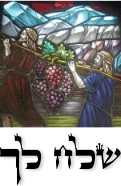
On the 9th of Av, after 40 days scouting the Promised Land, the spies returned to the camp of Israel at Kadesh carrying an enormous cluster of grapes, a giant-sized pomegranate and a huge fig (midrash states the fruits were so large that it took one man to carry the pomegranate, another to carry the fig, and eight to carry the cluster of grapes).
Instead of reporting back to Moses and Aaron, however, the spies appealed directly to the people. They began by affirming that the land is indeed "flowing with milk and honey" and pointed to the oversized fruits as evidence. However, they went on to say that the inhabitants of the land were fearsome, and there were even giants who lived there. In short, they concluded that it would be impossible for Israel to conquer the seven Canaanite nations who lived there, especially since they lived in fortified cities.
But Kalev (Caleb), the spy sent from Judah, tried to encourage the people: "Let us go up at once and occupy it, for we are well able to overcome it." The other spies (except for Yehoshua) contradicted him, however, and fomented greater fear in the people by describing the giants as descendants of the nefilim -- the supposed survivors of the great mabul (flood) who were so named because they caused those who saw them to fall down (nafal) in fear for their lives. "We seemed to ourselves like grasshoppers before them, and so we seemed to them."
Only Yehoshua and Kalev showed genuine emunah (faith) and insisted that the land could be vanquished, just as the LORD had promised.
|
|
|
|
|
|
|
|
|
|
|
The People Rebel
|
|
|
|
Upon hearing the evil report of the ten spies, and despite Kalev's encouragement that the LORD would give Israel the land He promised, the people wept and murmured about their situation. "Why is the LORD bringing us into this land, to fall by the sword? Our wives and our little ones will become a prey. Would it not be better for us to go back to Egypt?" And they said to one another, "Let us choose a leader and go back to Egypt." (Num. 14:3-4).
Upon hearing this, Moses and Aaron prostrated themselves before the people, while Yehoshua and Kalev rent their clothes and insisted that the LORD was able to defeat the enemies in the land: "for they are bread for us. Their protection is removed from them, and the LORD is with us; do not fear them" (Numbers 14:9). The people, however, picked up stones to stone them to death -- when the glory of the LORD appeared at the mishkan, before all the assembled people.
|
|
|
Moses' Intercession for Israel
|
|
|
|
The LORD then said to Moses, "How long will this people despise me? And how long will they not believe in me, in spite of all the signs that I have done among them? I will strike them with the pestilence and disinherit them, and I will make of you a nation greater and mightier than they."
Moses interceded for Israel, reminding the LORD that His reputation would be tarnished if He did not succeed in bringing these people into the land which He had promised to them. Would not the Egyptians believe that the LORD could not overpower the gods of the Canaanites if the people were destroyed before Him?
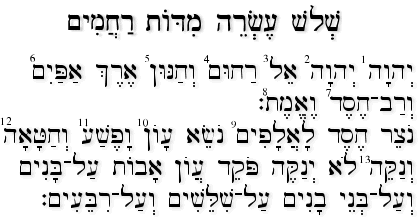
Moses then appealed to (a shortened version of) the shelosh esrei middot shel rachamim - the thirteen attributes that the LORD revealed to him after the Sin of the Golden Calf. Moses prefaced his appeal by saying, "And now, please let the power (koach) of the Lord be magnified (יִגְדַּל) as you have promised, saying, The LORD (יְהוָה) is slow to anger and abounding in steadfast love, forgiving iniquity and transgression..." In the Sefer Torah (Torah scroll), the letter Yod (י) of the word yigdal (יִגְדַּל), "be magnified," is written larger than normal. The sages say that the Yod, which equals the number ten in gematria, is emphasized in order to stress that the generation of the Exodus had sinned ten times against the LORD (Num. 14:22). Moses' great appeal to the LORD, however, was based on the meaning of the Name YHVH that was revealed to him when the covenant was renewed after the forty day period of teshuvah:
|
|
|
|
 |
|
|
|
 |
|
|
|
|
|
"The LORD, The LORD God, merciful and gracious, longsuffering, and abundant in goodness and truth, keeping mercy for thousands, forgiving iniquity and transgression and sin, and that will by no means clear the guilty; visiting the iniquity of the fathers upon the children, and upon the children's children, unto the third and to the fourth generation." (Exod. 34:6-7)
|
|
|
|
|
According to various traditional interpretations, these thirteen attributes of God's Name may be understood as follows:
- Adonai (יהוה) - I, the LORD, am the Compassionate Source of all of life and Ground of all being; I am the breath of life for all of creation. I am the God of all possible worlds and Master of the universe. Everything that exists is an expression of my loving will and kindness: עוֹלָם חֶסֶד יִבָּנֶה / olam chesed yibaneh: "The world is built with chesed" (Psalm 89:3[h]). Since the relative difference between existence and non-existence is infinite, God's creation represents infinite kindness, and since you exist, you likewise are expression of God's kindness and love. You do not exist because God needs you but soley because your life is willed by God as an expression of His love.
- Adonai (יהוה) - Though the LORD created the universe "very good" (טוֹב מְאד), He remained the Compassionate Source of life even after mankind sinned, and therefore the Name is repeated to refer to His loving relationship with alienated, fallen creation. I, the LORD, am also compassionate to one who has sinned and repented (i.e., the Creator gives us free will and the good gift of teshuvah). God created mankind for the sake of teshuvah - that is, our return to Him. God desires atonement with mankind even after sin and therefore continues to give existence to the world. "He makes his sun rise on the evil and on the good, and sends rain on the just and on the unjust" (Matt. 5:45). Moreover, as the Savior and Redeemer of the world through Yeshua, the LORD reveals kindness even to the evil, and even partakes of its presence by means of His sacrificial love on the cross. Since teshuvah can only exist after the advent of sin, Yeshua is called the Lamb slain from the foundation of the world (Rev. 13:8; Eph. 1:4; 1 Pet. 1:20).
In this connection, it should be noted that while God "wills" evil (in the sense of allowing the actions of the wicked to occur), he does not desire it. The sages note that while the Creator supports the existence of both the wicked and the righteous, he loves the righteous, and only their actions are desired by Him (Psalm 1:6). God wills the brokenness of the sinner so that the soul can return to Him by experiencing His salvation, love, and blessing.
- El (אֵל) - I, the LORD, am God the Almighty and Omnipotent;
- Rachum (רַחוּם) - I, the LORD, am merciful (rachamim (רַחֲמִים) means "mercy" and rechem (רֶחֶם) means "womb");
- Chanun (חַנּוּן) - I, the LORD, am gracious; I pour out my favor freely to all of creation. (Chen (חֵן) is the word for "grace");
- Erekh Apayim (אֶרֶךְ אַפַּיִם) - I, the LORD, am slow to anger and patient (the word erekh means "long" and af (אַף) means "nose." The idiom erekh apayim means "long suffering, patient");
- Rav Chesed (רַב־חֶסֶד) - I, the LORD, am abundant in love (חֶסֶד) to both the righteous and the wicked;
- Rav Emet (רַב־אֱמֶת) - I, the LORD, am truthful and faithful in carrying out promises;
- Notzer Chesed La'alafim (נצֵר חֶסֶד לָאֲלָפִים) - I, the LORD, retain chesed (love) for thousands of generations, taking into account the merit of our worthy ancestors (called zechut avot);
- Nosei Avon (נשֵׂא עָוֹן) - I, the LORD, carry away (i.e., forgive) iniquity (avon), defined in the tradition as wrongful deeds committed with perverse premeditation; I "carry iniquity away" (nasa) for the penitent;
- Nosei Pesha (נשֵׂא פֶשַׁע) - I, the LORD, forgive transgression (pesha), defined as wrongful deeds committed in a rebellious spirit; I "carry iniquity trangression" (nasa)
- Nosei Chata'ah (נשֵׂא חַטָּאָה) - I, the LORD, forgive sin (chet), defined as those wrongful deeds that were inadvertently committed; I "carry iniquity sin" (nasa);
- Nakkeh (נַקֶּה) - I, the LORD, will not cancel punishment, but I will clear the guilt for those who genuinely return to Me in teshuvah.
Notice, however, that in Moses' abbreviated appeal made on Israel's behalf (i.e., Num. 14:18), he did not refer to the LORD as the "God of Mercy and Grace" (אֵל רַחוּם וְחַנּוּן), nor did he add the qualifier that God was rav emet (רַב־אֱמֶת)....
|
|
|
|
|
|
The Decree of the LORD
|
|
|
|
The LORD accepted Moses' intercession but decreed that Israel's entry into the land would be delayed for another 38 years - for a total of forty years - a year for each day that the spies were in the land (Num. 14:32-35). During this exile, every person 20 years of age and older was fated to die in the wilderness - except for Joshua the son of Nun and Caleb the son of Jephunneh, the two spies who showed emunah (faith) in the word of the LORD (the other ten spies were immediately killed by a plague sent by the LORD).
According to midrash, since the Sin of the Spies occurred on the Ninth of Av, the LORD decreed it to be a day of judgment and mourning for all Israel. All these events are said to have occurred on Tishah B'Av:
|
|
|
|
- The LORD decreed that the original generation rescued from Egypt would die out in the desert and be deprived from entering the Promised Land because of the sin of the Spies
- The destruction of the First Temple (Babylonians, 586 B.C.)
- The destruction of the Second Temple (Romans, 70 A.D.)
- In 135 A.D. the Jews rebelled against Roman rule under the false Messiah Simon bar Kochba and were destroyed by Hadrian in the battle at Betar.
- The Gemara relates that Turnus Rufus, a Roman officer, plowed the area of the Temple under. Rambam (Maimonides) added that all the homes in Jerusalem were likewise ploughed under at this time.
- The expulsion of the Jews from England in 1290
- The expulsion of the Jews from Spain in 1496
|
|
|
Routed from the Promised Land
|
|
|
|
|
After hearing the judgment of the LORD, a group of remorseful Israelites decided to "repent" by taking matters into their own hands. Without either the "ark of the covenant of the LORD" or Moses' leadership, they presumptuously decided to storm a mountain on the border of land, but were summarily routed by the Amalekites and Canaanites. The first battle for the Promised Land, alas, was done in the strength of "the flesh" and resulted in disaster for Israel.
|
|
|
|
|
|
|
|
Further Instructions in the Desert
|
|
|
|
Almost inexplicably, the Torah portion shifts from the dramatic narrative to a discussion about offerings made at the Mishkan, reading somewhat like a passage from Leviticus. The laws of the menachot (meal, wine and oil offerings) are given, as well as the commandment to consecrate a portion of the dough (challah) to the LORD when making bread. Laws and sacrifices about unintentional sins are also given.
The narrative resumes with the story of a man who was gathering sticks on the Sabbath day. He is taken into custody and the LORD decrees that he should be executed by stoning outside the camp.
The parashah concludes with instructions for placing fringes (tzitzit) on the four corners of garments. Note that the tzitzit (צִיצִת) were intended to remind us not to fall into the same sin of unbelief that marked the spies: "It shall be a tassel for you to look at and remember all the commandments of the LORD, to do them, and not to "spy after" (i.e., תָתֻרוּ, the same word used to "spy" the land of Canaan) your own heart and your own eyes, which you are inclined to whore after" (Num. 15:39).
Truly it has been said, it was easy for the LORD to take the people out of Egypt, but it was hard for Him to take Egypt out of the people....
Postscript:
|
|
|
|
The entire generation of Israelites who left Egypt was sentenced to die in the desert. Every year until the fortieth year, on the eve of the Ninth of Av, Moses would command the Israelites, "Go out and dig!" The men would then go out of the camp, dig themselves graves, and sleep in them overnight. The next morning, a messenger would proclaim, "Let the living separate from the dead!" Many people had died that night, but the survivors would return to the camp for another year.
In the fortieth year no one died. Since they thought they might have counted the days incorrectly, they slept in their graves an additional night. This went on until the fifteenth of Av, when they finally realized that no more people would die, and they subsequently declared Tu B'Av a day of celebration (Talmud Yerushalmi, Ta'anit 4:6).
|
|
|
|
Additional Drash
|
|
|
|
This Torah portion primarily concerns the "Sin of the Spies." Instead of leaving Sinai to immediately take possession of the Promised Land, the Israelites first called for a "spying expedition" - a tragic error that would result in the LORD's decree that the entire generation that was rescued from Egypt would die in the desert. Only Joshua and Caleb were spared this judgment from Heaven.
How did Joshua and Caleb escape this great national tragedy? A passage from the Talmud (Tractate Sotah 34b) states that Moses foresaw the treachery and faithlessness of the spies (meraglim) and therefore renamed Hoshea (הושׁע) to Yehoshua (יהושׁע) -- in order to remind him that YHVH (י) must always come first. Another passage from the Talmud (Sanhedrin 107a) states that the extra Yod came from Sarai (שׂרי), who had "given up" the Yod to form the name Sarah (שׂרה). In this story, the Yod appeared before the LORD and complained about being deleted from this righteous woman of valor. The LORD, however, reassured Yod that the day would come when it would become the first letter of a great tzaddik's name (i.e., Yehoshua).
Also according to the Talmud, Caleb, who did not receive a special blessing from Moses, separated himself from the spies and went to Chevron (Hebron) to the cave of Machpelah where he prayed for protection according to the merits of the Patriarchs who were buried there (Sotah 34b). Note that the singular verb is used in Num. 13:22: [ויבא עד־חברוֹן, "and he came to Hebron"], which the midrash says refers to God Himself who met Caleb there). The Torah sages further note that Caleb is called the "son of Yefuneh", which means [a face] "turned away," suggesting that he turned away from the evil schemes of the other spies.
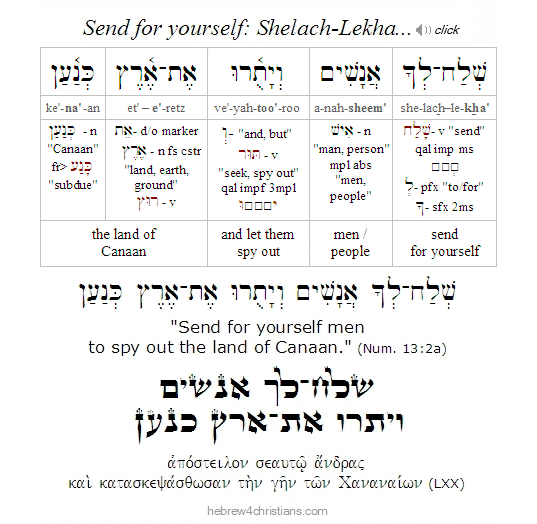
The Midrash (Tze'enah Urenah) notes that this Torah portion opens with God's command to send spies: "Send for yourself men that they may spy" (Num. 13:2) and correlates this act of sending with Proverbs 21:31: "The horse is prepared for the day of battle, but salvation comes from the LORD." The midrash goes on to say that a person should do as much as possible (in the realm of human effort) yet his heart should rely entirely upon God for the outcome (Prov. 16:9). Yet another Midrash states, however, that the sin of Israel was that they sent spies when they ought to have followed the Shekhinah cloud that was leading them in the desert. According to this account, Moses was afraid to speak out against the people, and the LORD answered, "Send for yourself" - in other words, "do what you want, Moses." Yet some other sages note that "send for yourself" meant "send them for your own benefit." Since Moses was decreed to die before entering the Promised Land, if the spies had sinned and Israel was turned back, Moses would live for additional years as Israel's shepherd. Two sages, three opinions, chaverim....
Rashi notes that the Sin of the Spies was essentially that of lashon hara -- speaking evil by producing an evil report -- in this case, speaking against the nation of Israel (or more precisely, against God Himself, since His promise to give the land to the people was not held in sufficient esteem -- despite the miracles the Exodus generation had witnessed). The spies terrified the people by referring to the "children of the giants" (יְלִדֵי הָעֲנָק) and the heavy fortifications of the cities in the Promised Land. Essentially the spies claimed that "the people are stronger than God" (the phrase כִּי־חָזָק הוּא מִמֶּנּוּ can be understood in this sense), and the Israelites wept all that night and wished for death (Num. 14:2).
The Midrash says that since the people wept for no reason that night, God would provide them with reason enough. It was the Ninth of Av, and God decreed this to be a night of perpetual weeping. "On this night you shall cry for your Temple, which shall be destroyed on this night" (Midrash Rabbah).
The midrash goes on to comment that God did not immediately destroy the adult generation of the Israelites for the sake of His reputation, "lest the enemy say that the LORD does not have the power to bring them into the land." Moses' appeal on behalf of Israel was also based on avoiding chillul HaShem (desecration of God's Name): Wouldn't the Egyptians likewise think that God did not have the power to bring the people into the land if He should kill them in the desert? (Num. 14:12-14).
|
|
|
|
A Story about the Power of the Tongue
|
|
|
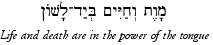
Regarding the power of the tongue, the story is told of a king whose son was very sick. The doctors told the king that only the milk from a lioness would save the prince, but how could such be had? A man approached the king and told him that if the king gave him ten goats, he would get the desired milk. The king agreed and promised the man great honor and riches if he succeeded. Thereafter, each day the man took one goat into the lion's den and offered it to them for food. Day by day passed, and the lions began to trust the man's presence. By the tenth day, the lions had gained enough trust in him enough to allow him to milk the lionesses.
Later that night the man had a strange dream: An argument broke out as to which of his bodily organs was responsible for this great success. First the hands claimed credit, then the eyes, and so on. Finally, the tongue said, "I caused this, for I asked the king for ten goats." The other body parts scorned the tongue's suggestion, but it replied, "You shall soon learn that everything depends on me."
The following day, among great pomp and ceremony, the man presented the milk to the king. When he approached the throne, however the words tumbling from the man's tongue were, "I present to you, O Majesty, the dog's milk which you requested!" Infuriated, the king sentenced the man to die and threw him into prison. That night he dreamed yet again and the tongue said to the man's organs, "You see now that I am greater then the rest of you? Because of me you shall all be punished." The other organs all admitted that indeed the tongue was the greatest and appointed it their leader. "Just save us from death!" they implored.
The next day, as the man was being lead out to be hanged, he insisted that he could indeed cure the king's son. When he explained to the king that he had misspoken, the king tested the milk and gave it to his son, who then immediately recovered. The man was spared and was made a great noble (adapted from Midrash Shochar Tov).
|
|
|
|
A Note about Tzitzit
|
|
|
|
|
This portion of Torah also gives the commandment regarding tzitzit or "fringes" (Num. 15:38ff; see also Deut 22:12; Matt. 9:20; 14:36; 23:5). Rashi notes that the word tzitzit
(ציצת) has the numerical value of 600 (in its Mishnaic spelling - which adds another Yod to the Torah's spelling) which, when combined with the five knots of eight threads yields a total of 613, the supposed number of the commandments (taryag mitzvot) listed in the Torah as enumerated by some of the Jewish sages:
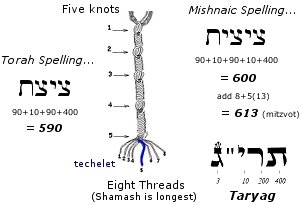
But what about the Hebrew value of the word (ציצת) that adds only to 590? Some of the sages have said that since the word לציצת appears once, and since Lamed (ל) equals 30, it "makes up for" the three times in the Torah when tzitzit is spelled without the Yod... The four corners (of the tallit) represent the four expressions of redemption from Egypt: "I will take you out; I will save you; I will redeem you; and I will take you as my own."
|
|
|
|
The Haftarah for Shelach is a study of contrast with the parashah reading. Here we fast-forward some 40 years to the time when the second generation of Israel was about to enter the land, now under the leadership of Yehoshua ben Nun, Moses' successor.
This time, the delegation of spies consisted of just two members: Kalev and Phineas, sent in secret to gather information about the city of Jericho. According to Jewish tradition, Kalev was the same man who (along with Yehoshua) was a faithful spy during the first spying mission, some 40 years before, and Phineas was the priest who had saved the people from a disastrous plague (Numbers 25:7-8).
At the beginning of the reading, the two spies arrive at the "house of Rachav" (Rahab), embedded in the thick wall of the city. Rachav is said to be ishah zonah - or a prostitute, and her house might have been some sort of inn for travelers. The Talmud describes Rachav as one of the four most beautiful women in the history of the world: Sarah, Rachav, Abigail and Esther).
|
|
|
|
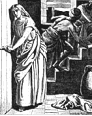
The King of Jericho heard that spies were in the city - at the house of Rachav - but she quickly hid them among the flax mats on her roof. Troops were dispatched to her house who ordered her to turn them over, but Rachav lied to them and told them they had left, thereby sending them on a false pursuit.
|
|
|
|
|
|
After misleading the troops of the king, Rachav went back to the spies and obtained promise for her family's protection when Israel came to take the city. For she had heard of the glory of Israel and believed in the LORD's deliverance. The spies agreed, and Rachav lowered them by a rope over the walls. She further instructed the spies to hide in the mountains for three days, until the soldiers pursuing them have given up their search. The two spies then added the special instruction that Rahav put a scarlet cord in the window to mark the location as a place of refuge from the coming battle. They could not secure the safety of Rahav or her family if they were to leave the place. Rachav agreed to these conditions and the two spies successfully escaped.
They gave their report to Yehoshua saying "Truly the LORD has given all the land into our hands. And also, all the inhabitants of the land melt away because of us."
When the city of Jericho later fell (Numbers 6:17-25), Rachav and her whole family were preserved according to the promise of the spies, and were incorporated among the Jewish people. She afterwards became the wife of Salmon, a prince of the tribe of Judah (Ruth 4:21; 1 Chr. 2:11; Matt. 1:5, though some believe this was none other than Yehoshua ben Nun himself). According to the genealogy of Matthew, Rachav was the mother of Boaz (who married Ruth), and was therefore the great great grandmother of King David. Our Mashiach Yeshua Himself descended from David's line, so Rachav is in the lineage of the Messiah Himself! Truly a remarkable eshet chayil (woman of valor).
|
|
|
|
|
|
|
 |
|
|
|
Brit Chadashah Overview
|
|
|
|
The Brit Chadashah portion warns those who are followers of the Mashiach Yeshua to exercise faith and not lapse into unbelief, as did the desert generation of Israelites who failed to enter into the promises of the LORD.
After pointing out the superiority of the LORD Yeshua to the service of Moses (Hebrews 3:1-6), the writer of the book quotes from Psalm 95 and admonishes:
For who were those who heard and yet rebelled? Was it not all those who left Egypt led by Moses? And with whom was he provoked for forty years? Was it not with those who sinned, whose bodies fell in the wilderness? And to whom did he swear that they would not enter his rest, but to those who were disobedient? So we see that they were unable to enter because of unbelief.
Therefore, while the promise of entering his rest still stands, let us fear lest any of you should seem to have failed to reach it. (Hebrews 3:16-4:1)
Yehoshua ben Nun was a type of Mashiach, the successor to Moses who went over the Jordan - into the place where Moses could not go - i.e., the land of promise. In the same way, those who are called to follow Yeshua must enter into the kingdom by faith and not by relying on the "spying eyes" of the flesh.
Blessing:
|
|
|
|
 |
|
|
|
|
|
For Further Study:
|
|
|
|
|
|
|
Hebrew Audio Files:
|
|
|
|
|
Click the following links to hear the desired chapters read from this week's Torah:
|
|